|
|
|
|
 |
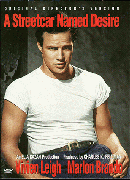
A Streetcar Named Desire
(1951)
Review This was the moment acting forever changed on film. The moment Hollywood went from being an escapism factory with meticulously crafted technical performances to becoming a scene for raw, inner, uncontrollable emotion. After running two full years on Broadway with the same personnel as are ultimately in the movie (minus Vivien Leigh) to rave reviews and box office success, it was only a matter of time before a screen version would appear. However, to adapt Tennessee Williams' thematically groundbreaking play was a risky endeavour which the studios seemed unwilling to take at the time. That movie audiences and censors were going to be ready for a steamy, morally questionable tale of lust and violence (often in combination), seemed very unlikely in the late 1940s. Luckily, Warner Brothers took the chance and director Elia Kazan's stubbornness and guile made the transition from stage to screen almost unnoticeable.
Kim Hunter's performance is in many ways the bravest, since she responds to Stanley's nature and Brando's acting in such a self-determining, liberal way. Despite the fact that she is totally dependent on her man, she is no doubt the strongest person in the play, knowingly letting her passion and lust rule over what she considers trivial everyday hassle. There is a scene - perhaps the film's most very famous - in which we get to see and fully understand Stella's passion. The scene (which was modified to please censors in 1951, but has now been put back into its original form, showing Hunter's lusting face) is perhaps primarily known for Brando's aching cries ("Stella! Hey Stella!"), but it is Hunter's fervent acting which creates the ultimate effect. Tennessee Williams' script is at its best discussing sealed issues in a discreet and implicit manner. Homosexuality, open passion, and liberated female sexuality were not explicit themes in neither film nor society at the time. These subjects are forcefully and delicately discussed throughout A Streetcar Named Desire - largely helped and elaborated by Alex North's groundbreaking, erotic jazz score. And Kazan, who was one of the great actor's directors, expertly captured the power of these themes on film while still keeping the censors at bay. Remarkably, A Streetcar Named Desire seems as potent and edgy today as it did over half a century ago. I put that down to the timelessness of Brando's performance, in which we acquaint ourselves with primal human instincts which codex and etiquette will never alter.
|
|||||||||||||||||||||||||||
 |











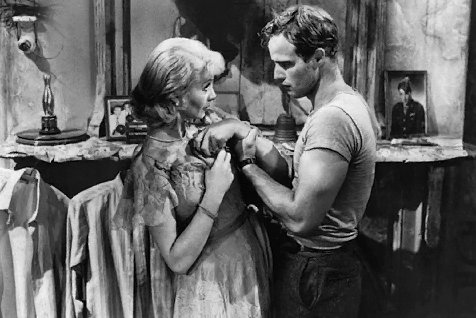 The
main tool and reason for A Streetcar Named Desire's pulsating,
captivating presence, is Marlon Brando's revolutionary acting. While
Vivien Leigh and Karl Malden both gave powerful and deep Academy
Award-worthy performances, theirs was conventional acting. Brando, on the
other hand, changed the history of cinema. And he did so arguably only
by exposing his own ambiguous nature. The physicalness in Stanley
Kowalski - ranging from his brutal, uncontrollable aggression to his
equally uncontrollable sexual desire - was completely unprecedented. And
thanks to Brando's magnetic but still naïve nature, he redefined the
rules for audiences sympathy with film characters. They were distressed
by him, but at the same time overpoweringly attracted to him.
The
main tool and reason for A Streetcar Named Desire's pulsating,
captivating presence, is Marlon Brando's revolutionary acting. While
Vivien Leigh and Karl Malden both gave powerful and deep Academy
Award-worthy performances, theirs was conventional acting. Brando, on the
other hand, changed the history of cinema. And he did so arguably only
by exposing his own ambiguous nature. The physicalness in Stanley
Kowalski - ranging from his brutal, uncontrollable aggression to his
equally uncontrollable sexual desire - was completely unprecedented. And
thanks to Brando's magnetic but still naïve nature, he redefined the
rules for audiences sympathy with film characters. They were distressed
by him, but at the same time overpoweringly attracted to him.