|
|
|
|
 |
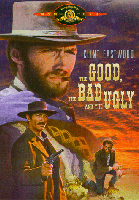
Il buono, il brutto, il
cattivo (1966) Preceded by: Per qualche dollaro in più (1965)
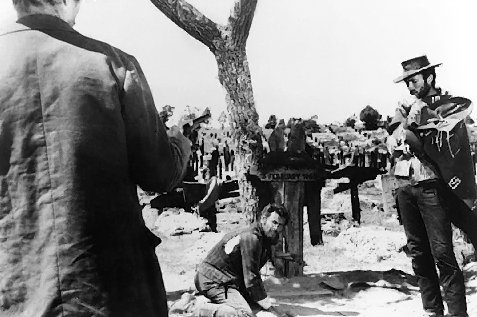
After honing his skills as a filmmaker and experimenting with increasingly larger and more pompous themes in the two first films of his Dollars Trilogi, Sergio Leone upped the ante and got it all right with the gargantuan, iconographical Il buono, il brutto, il cattivo. In this film, Leone reused several of the elements from his first two westerns, notably the nature of the principle character and the fascination for wide, desolate sets and extreme, dwelling close-ups, and combined this with a far more poignant writing and sociological observations which gave the film an added emotive aspect. What is most striking with Il buono, il brutto, il cattivo, is Leone's confidence going in. It is evident that he feels he has kept polishing a diamond for a while, because this time, his iconic images are larger and more substantially tied up to the thematics – from the mute, lingering character introductions in the opening, through the agonizing, often torturing portrait of the cruelness of the west (as Leone envisioned it), and to the magnificent set-pieces. The latter are what sets Il buono, il brutto, il cattivo apart completely, because this film not only uses its striking set-pieces for dramatic effect and action value; in here they are the cornerstones of the thematic line. Il buono, il brutto, il cattivo was Leone's final coup de grace on the traditional western hero of the studio era who boasted a moral conscience and a gentlemanlike manner to fit the refined '30s and '40s. John Wayne had progressively made this hero more rugged, but it was Sergio Leone and Clint Eastwood who took away his sanctimony and made him a selfish and opportunistic anti-hero. The fascination from and attraction on the public was unmistakeable – largely because this character was more identifiable for most people. Blondie was human in essence (though superhuman in ability), flawed and inconsiderate, but still largely conscientious deep inside. The point made by Leone was that under such conditions as these men lived, nothing much better was to be expected. He thus destroyed the myth about the knight-in-shining-armourish cowboy and instead made a point about the fine line which existed between the good (Blondie) and the bad (Tuco, read: ugly). Sergio Leone took an Italian crew and three American B-actors to the Spanish desert and shot the most iconic western to date. Bad dubbing and overdone sound production could not stop this epic, relentless film becoming one of the most trendsetting in the history of cinema – inspiring filmmakers from Peckinpah to Tarantino. Leone views the callous nature of the American west through a revitalized lens of poetic realism and backdrops it all against his innovative and purified film style. In Il buono, il brutto, il cattivo, the most archetypical of characters become the most interesting human beings and the most inevitable narrative development becomes a stirring and electric showdown.
Tuco:
[trying to read a note] "See you soon, id...
id... ids..." Tuco: "There are two kinds of people in the world, my friend: Those with a rope around the neck, and those who do the cutting." [Tuco is sitting in a
bathtub with a lot of foam when the One Armed Man enters the room] Blondie: "You see, in this world there's two kinds of people, my friend: Those with loaded guns and those who dig. You dig."
|
||||||||||||||||||||||||||||||||
 |